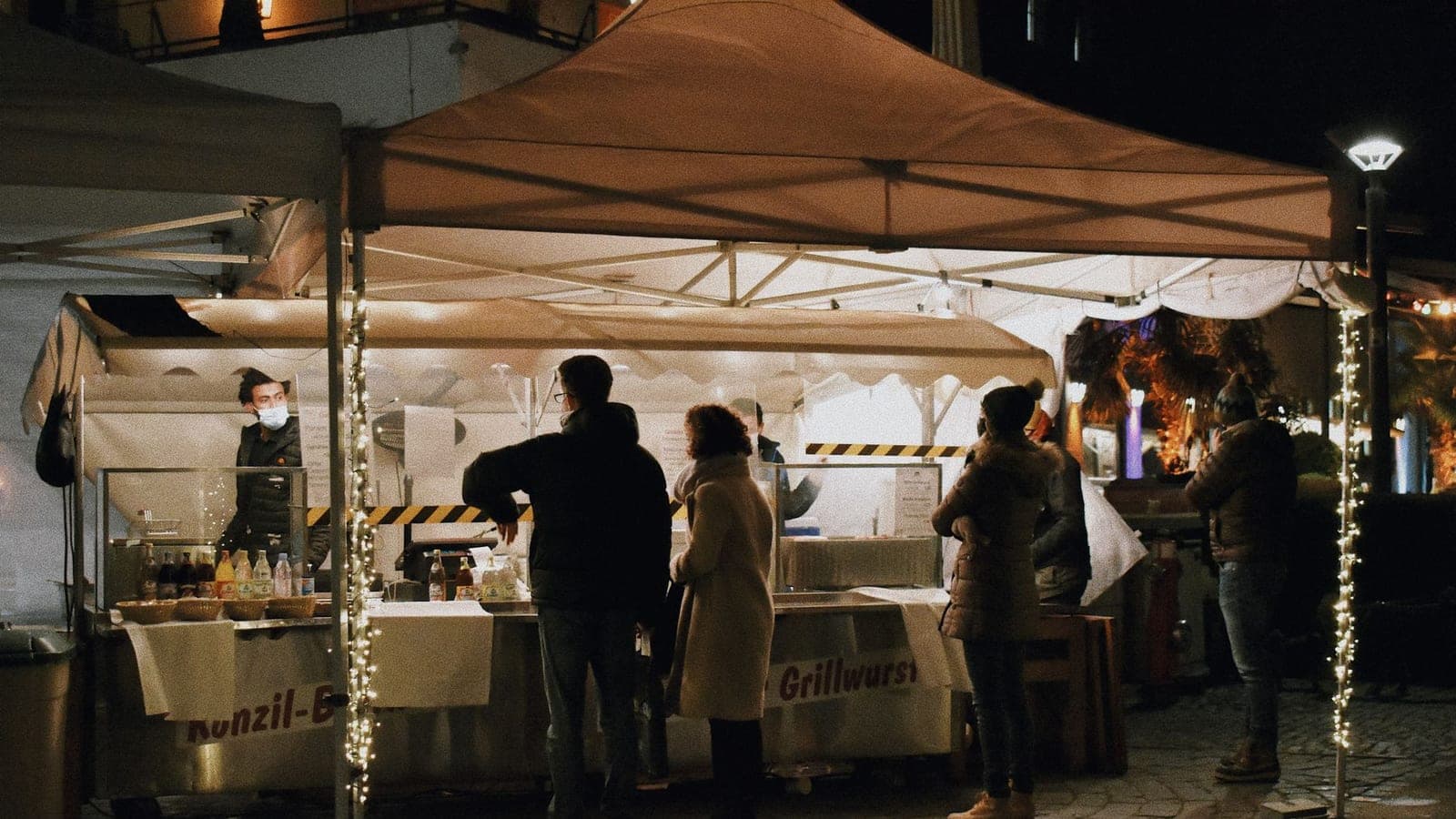
The organiser of a food festival in Valencia has a problem that doesn't appear in any events manual: they have sold 3,000 general admission tickets for Saturday, and at 14:00 all of those people want to eat at the same time. Queues at the stalls top 45 minutes, the food trucks run out of stock by 15:30, and the event hashtag fills up with complaints about waits and sold-out dishes. On Sunday, sales drop by 40% because Saturday's attendees have shared their frustration on social media.
Food and drink events have a structural problem that sets them apart from almost any other kind of event: capacity is set by the kitchen, not the venue. You may have a space for 5,000 people, but if the food stalls can only serve 200 people an hour, you will have a logistical disaster every day.
Ticketing for food and drink events is not just about selling tickets. It is about controlling flows, managing limited-capacity sessions, selling extra experiences, collecting dietary information, verifying ages when alcohol is involved, and creating packages that maximise the average ticket value without overloading operations. This guide covers all of that.
Why sell tickets by time slot?
General admission with no time slot is the biggest mistake a food event organiser can make. If you sell 2,000 tickets for Saturday and nothing more, everyone will arrive between 13:00 and 14:00, and the experience will be dreadful.
How to design the slots
Timed entry limits the number of people who can come in during each time band. A typical design for a food festival running from 12:00 to 23:00:
| Slot | Hours | Maximum capacity | Audience profile |
|---|---|---|---|
| Midday | 12:00 - 15:00 | 800 | Families, relaxed lunch |
| Afternoon | 15:00 - 18:00 | 600 | Groups, grazing, beer |
| Evening | 18:00 - 21:00 | 1,000 | Dinners, cocktails, atmosphere |
| Late night | 21:00 - 23:00 | 700 | Drinks, music, after-party |
Slots don't have to be rigid. You can sell tickets that allow entry from a set time with no exit time, or tickets with a fixed window (3 hours from entry). It depends on your operation and the behaviour you want to encourage.
Pricing by slot
Not all slots are worth the same. The evening slot (dinner) is usually the most in demand. Midday on a weekday is the least. Adjusting the price by slot is the most direct way to balance demand:
- Premium slot (evening, Saturday): full price
- Standard slot (afternoon): 15-20% less
- Off-peak slot (weekday midday): 30-40% less
- Early bird: independent of the time slot, for those who buy in advance
This model doesn't just fill the less popular slots: it generates revenue that would not otherwise exist. Plenty of people wouldn't come to the event at full price, but will happily come on a Tuesday lunchtime at 35% off.
If you want to go deeper into ticket-type strategies and how to combine them, our guide to event ticket types covers the most common models.
Access control tied to the slot
There is no point selling by slot if you then fail to check that each person enters in their own slot. The ticket's QR code must be validated against the assigned time slot. If someone with an afternoon ticket tries to get in at 12:30, the system should reject the scan and show a clear message to the door staff.
This prevents the "trick" of buying the cheap slot and trying to walk in anyway, which is more common than it seems.
How do you sell tastings, masterclasses and workshops by session?
Within a food event, limited-capacity experiences generate the highest average ticket value and the best attendee satisfaction. A wine tasting for 20 people with a renowned sommelier has an enormously higher perceived value than general admission.
Typical session structure
A full food festival can offer:
- Wine tastings: 15-25 people, 60-90 minutes, 4-6 wines, paired with tapas
- Craft beer tastings: 20-30 people, 60 minutes, 5-8 beers
- Olive oil tastings: 10-15 people, 45 minutes, 4-5 varieties
- Cooking masterclass: 12-20 people, 90-120 minutes, ingredients included
- Guided pairing: 20-30 people, a 4-5 course dinner with selected wines
- Children's cooking workshop: 10-15 children (with an adult), 60 minutes
- Cooking demonstration: 50-100 people (watching only), 45 minutes, tasting at the end
Each session has its own capacity, schedule, price, requirements (minimum age for alcohol tastings) and included materials.
Selling sessions as an add-on or on their own
Two models work:
Session as an add-on: the attendee first buys their general admission ticket and then adds specific sessions. Advantage: higher average ticket value. Risk: if the session purchase is separated too far from the ticket purchase, sessions end up half empty.
Session with entry included: the session price includes access to the event. Advantage: simplicity for the attendee. Risk: it can cannibalise general ticket sales if the session price isn't well calibrated.
The best option is usually a hybrid model: sessions are sold as an add-on with a 15-20% discount for those who already have a general admission ticket, and at full price (with access included) for those who buy only the session.
Waiting lists by session
The most attractive sessions sell out fast. A well-managed waiting list has two functions:
- 1Capture unmet demand: if 40 people want a tasting with 20 places, you have the data to schedule a second session.
- 2Fill cancellations: if someone cancels, the first person on the list gets a notification and has 2 hours to confirm before it passes to the next.
The waiting list is also valuable commercial information for next year: it tells you exactly which experiences have more demand than you can meet.
Which add-ons and bundles maximise the average ticket value?
Food and drink events are perfect for selling add-ons because the product is tangible and immediate. Attendees can see, smell and taste what they are buying.
Common add-ons
- Tasting glass: a reusable crystal glass with the event logo (EUR 5-8). Attendees use it during the event and take it home as a souvenir.
- Tasting tokens: packs of 5 or 10 tokens redeemable for tapas at the stalls. They simplify cash payments and speed up queues.
- Premium pairing: access to an exclusive bar with a selection of wines or craft beers not available at the general stalls.
- Recipe book: by the guest chef, signed if it coincides with a cooking demonstration.
- Apron and hat pack: for the cooking workshops.
- VIP parking: if the venue has limited parking.
- Early access: entry 30 minutes before general opening to get first pick.
Bundles that work
Combined packs raise the average ticket value by 25% to 45% compared with selling the ticket alone:
- Foodie Pack: ticket + 10 tokens + tasting glass → 15% discount on individual purchase
- Gourmet Pack: ticket + masterclass + premium pairing → 20% discount
- Couple Pack: 2 tickets + 20 tokens + 2 glasses → 10% discount
- Family Pack: 2 adults + 2 children + children's workshop + 10 tokens → 25% discount
The key is that the bundle is more attractive than buying each item separately, but not so cheap that you lose margin. A 15-20% bundle discount is usually the sweet spot.
Event merchandise
T-shirts, tote bags, aprons, chopping boards with the event logo. Merchandise sells well at food and drink events because the audience tends to have high purchasing power and values well-designed products. Offering it as an add-on at ticket purchase guarantees stock (it is produced to order) and simplifies logistics on the day of the event.
What dietary information do you need to collect?
At a food festival it seems less critical than at a corporate event with a seated menu, but dietary information is just as important for two reasons: food safety and the attendee experience.
Data to collect at registration
- Severe allergies: information that can save a life. An attendee with a severe nut allergy needs to know which stalls are safe for them.
- Intolerances: gluten, lactose, fructose. These are not medical emergencies, but they ruin the experience if they are not taken into account.
- Diets: vegetarian, vegan, alcohol-free. Essential for sizing the offering at the stalls.
How to use that data
The dietary information collected at registration has two direct uses:
For the attendee: in the event app or on a printed map, each stall has icons showing the options it offers (vegan, gluten-free, nut-free). Attendees with restrictions don't have to ask stall by stall: they know in advance where they can eat.
For restaurants and food trucks: before the event, you send them a summary of attendees' dietary needs. If 12% of attendees are vegetarian, stalls can adjust their proportions. If 8% have a gluten intolerance, stalls offering gluten-free options have a commercial argument for taking part.
If you want to go deeper into improving the attendee experience beyond the food, our guide to the attendee experience covers the key points.
How do you verify age at events with alcohol?
Any food and drink event that includes wine, beer, spirits or cocktail tastings has a legal obligation to verify that attendees are of legal age. In Spain, the minimum age is 18.
Verification at purchase
The first filter is at ticket sale. If the event includes alcohol (general admission with a bar) or if the attendee buys a tasting session, the system must:
- Ask for date of birth and validate that the buyer is over 18
- Show a clear legal notice on the ban on selling alcohol to minors
- Flag on the ticket/QR whether the attendee is an adult or a minor
Verification at the door
Online verification doesn't replace the check at the door, but it makes it easier. If the QR code already includes age verification, access staff only need to check in case of doubt. For tasting sessions, verification is mandatory: ID checked in hand before entry.
Tickets for minors
Food festivals are not only for adults. Families are an important segment, especially in midday slots. Tickets for minors should:
- Have a reduced price or be free (depending on the event's policy)
- Automatically exclude sessions with alcohol
- Allow entry only when accompanied by an adult with a valid ticket
- Give access to the children's cooking workshop, if there is one
A well-configured ticketing system won't let a minor buy (or have someone buy for them) a ticket to a wine tasting. It seems obvious, but if it isn't automated, it happens.
Partnerships with restaurants, wineries and brands
A food festival is a showcase for restaurants, wineries and food brands. The relationship with these partners has direct implications for ticketing.
Participation models
- Own stall: the restaurant sets up its stand and sells directly. It is interested in ticketing for the footfall the event generates.
- Token stall: the restaurant accepts event tokens instead of cash or card. It invoices the organiser after the event, minus a commission (typically 10-15%).
- Session sponsorship: a winery sponsors a tasting in exchange for visibility and a presentation of its wines. Attendees don't know (or don't care) who is paying: they enjoy the experience.
- Product included in the bundle: an olive oil brand supplies small bottles for the Gourmet Pack in exchange for visibility on the sales page.
Dashboards for partners
Each participating restaurant or winery needs access to its own data:
- Tokens redeemed at its stall (if applicable)
- Number of attendees who visited its stand
- Attendee ratings (if there is a post-event survey)
- Sales of the session it sponsors
- Comparison with other stalls (anonymised)
This data is the basis for negotiating participation next year. A restaurant that sees it served 800 dishes and scored 4.7/5 will come back without thinking twice. One that served 200 and scored 3.2 will ask for a better location or decide not to take part.
What should a VIP food and drink experience include?
VIP attendees at a food and drink event can account for 5-10% of tickets sold but 20-30% of revenue. Designing the VIP experience well is not a luxury: it is a business decision.
What a VIP food and drink ticket includes
- Early access: 30-60 minutes before general opening
- Exclusive area: a terrace, garden or enclosed space with differentiated catering
- Premium bar: reserve wines, signature cocktails, special beers not available in the general area
- Guided tasting: a tour of the best stalls with a food guide
- Meet & greet with chefs: 15-20 minutes with the event's star chef, photos, questions
- Gift bag: sponsors' products, an exclusive recipe book, an engraved glass
- Reserved parking: or a transfer service from a meeting point
Pricing the VIP experience
A VIP ticket should cost between 2.5x and 4x the general admission price. If general admission costs EUR 25, VIP should sit between EUR 65 and EUR 100. Below 2.5x, the margin doesn't justify the extra operation. Above 4x, the price hurts conversion.
Limiting VIP capacity
Exclusivity is part of the value. If you sell too many VIP tickets, the experience degrades and the VIP area becomes just another general area, only more expensive. A maximum of 10% of total capacity as VIP is the usual benchmark. At an event of 2,000 people, no more than 200 VIPs.
How do you manage payments inside the event?
Inside a food festival, payments are a bottleneck. If each stall charges separately with its own card terminal, queues get longer and the experience suffers.
Token systems
Physical or digital tokens are the standard at large food festivals:
- Attendees buy tokens at the entrance or at points of sale around the venue
- Each token has a fixed value (e.g. 1 token = EUR 3)
- Dishes cost 1, 2 or 3 tokens depending on size
- The stall collects tokens and invoices the organiser at the end of the event
- Leftover tokens can be returned (refund) or the attendee loses them
Digital tokens (in an app or on a cashless wristband) eliminate the problems of physical tokens (they get lost, forged, or pile up on the floor) and add real-time consumption data: which stalls sell the most, at what times, which products.
Cashless with NFC wristbands
The natural evolution of tokens is the cashless system. Attendees top up their wristband with real money (at the box office, online or from the app) and pay by tapping the wristband on the stall's terminal. No cash, no queues, complete data.
For a food festival, cashless has an additional advantage: it drastically reduces food waste. Stalls see in real time how many transactions they are running and can adjust production. If at 19:00 a stall is doing 50 transactions an hour and has stock for 3 more hours, it doesn't need to cook more. Without real-time data, the tendency is to overproduce "just in case".
What certifications and regulations do you need to comply with?
Events with food are subject to regulations that other events are not. Ignoring them is not an option.
Health registration
In Spain, any event where food is served needs prior notification to the competent health authority (the regional health department of the autonomous community). Food stalls must comply with food handling regulations and have accredited training.
Allergen information
Since 2011 (EU Regulation 1169/2011), it has been mandatory to provide information on the 14 main allergens at any food point of sale. This applies to every stall at the food festival. The ticketing system can help by generating the allergen sheets for each stall as part of the event documentation.
Alcohol licence
If the event includes alcohol sales, you need the corresponding municipal licence. In some autonomous communities, selling alcohol at outdoor events is subject to time or zone restrictions. Your ticketing must reflect these restrictions: if alcohol cannot be sold after 23:00, tasting sessions cannot be scheduled for 23:30.
Sustainability and waste
More and more councils require a waste management plan for food and drink events. Reusable tableware, separating organic waste and cutting plastic are requirements, not options. Ticketing can contribute: digital tickets (zero paper), digital tokens (zero plastic), a reusable glass as an add-on (fewer single-use cups).
How do you measure the success of a food and drink event?
A food festival's metrics go beyond tickets sold. You need operational data to improve each edition.
Sales and attendance metrics
- Tickets sold per slot: which slots sell out and which are left over?
- No-show rate per slot: do some slots have more no-shows than others?
- Average ticket value: ticket + add-ons + tokens. How much does each attendee spend on average?
- Add-on conversion: what percentage of ticket buyers add sessions or packs?
- Session sales vs. capacity: which sessions fill up and which don't reach 50%?
Operational metrics
- Consumption per stall: tokens redeemed or cashless transactions per stall and hour
- Peak consumption hour: at what time does the highest volume of transactions occur?
- Average time on site: from entry scan to exit (if there is an exit scan) or last transaction
- Geographic distribution of buyers: where do attendees come from? Crucial for deciding the location of future editions
- Sales channel: what percentage buy online vs. at the box office on the day?
Satisfaction metrics
- Event NPS: a post-event survey sent to all attendees
- Rating per stall: if you integrate a QR survey at each stall
- Social media mentions: volume, sentiment, hashtag, shared photos
- Repeat rate: how many attendees from the previous edition come back? You need to identify buyers across editions (email as the key)
Report for partners and sponsors
Each restaurant, winery and sponsoring brand receives a personalised report with its data. This report is the best partner retention tool: if they can see the return on their participation in numbers, the decision to come back is easy.
Platforms such as Futura Tickets generate these reports automatically from ticketing and consumption data, so you don't have to cross-reference spreadsheets by hand during the two weeks after the event.
What does a food festival's ticketing timeline look like?
To close, an indicative calendar of ticketing actions for a food festival:
| Weeks before | Action |
|---|---|
| 12 weeks | Define time slots, sessions, prices and bundles |
| 10 weeks | Set up the sales page, forms and add-ons |
| 8 weeks | Launch early bird sales. Start marketing campaigns |
| 6 weeks | Open sales of sessions and VIP experiences |
| 4 weeks | First sales analysis. Adjust slots or prices if there is an imbalance |
| 2 weeks | Close dietary information registration. Send data to stalls |
| 1 week | Set up access control, test scanners, brief the staff |
| Event day | Monitor in real time: tickets scanned, consumption per stall, incidents |
| +1 week | Generate post-event reports, send satisfaction survey |
| +2 weeks | Send reports to partners and sponsors. Close settlements |
Food and drink events grow every year in Spain. In 2025 alone, more than 400 registered food festivals were held, not counting the hundreds of tastings, local fairs and restaurant events. The organiser who masters timed-entry sales, VIP experiences and data management for each attendee has an enormous competitive advantage over one who keeps selling general admission tickets and crossing their fingers that the logistics will hold. If you are organising a food and drink event, also see our guide on how to organise a festival in Spain and the key metrics for promoters.