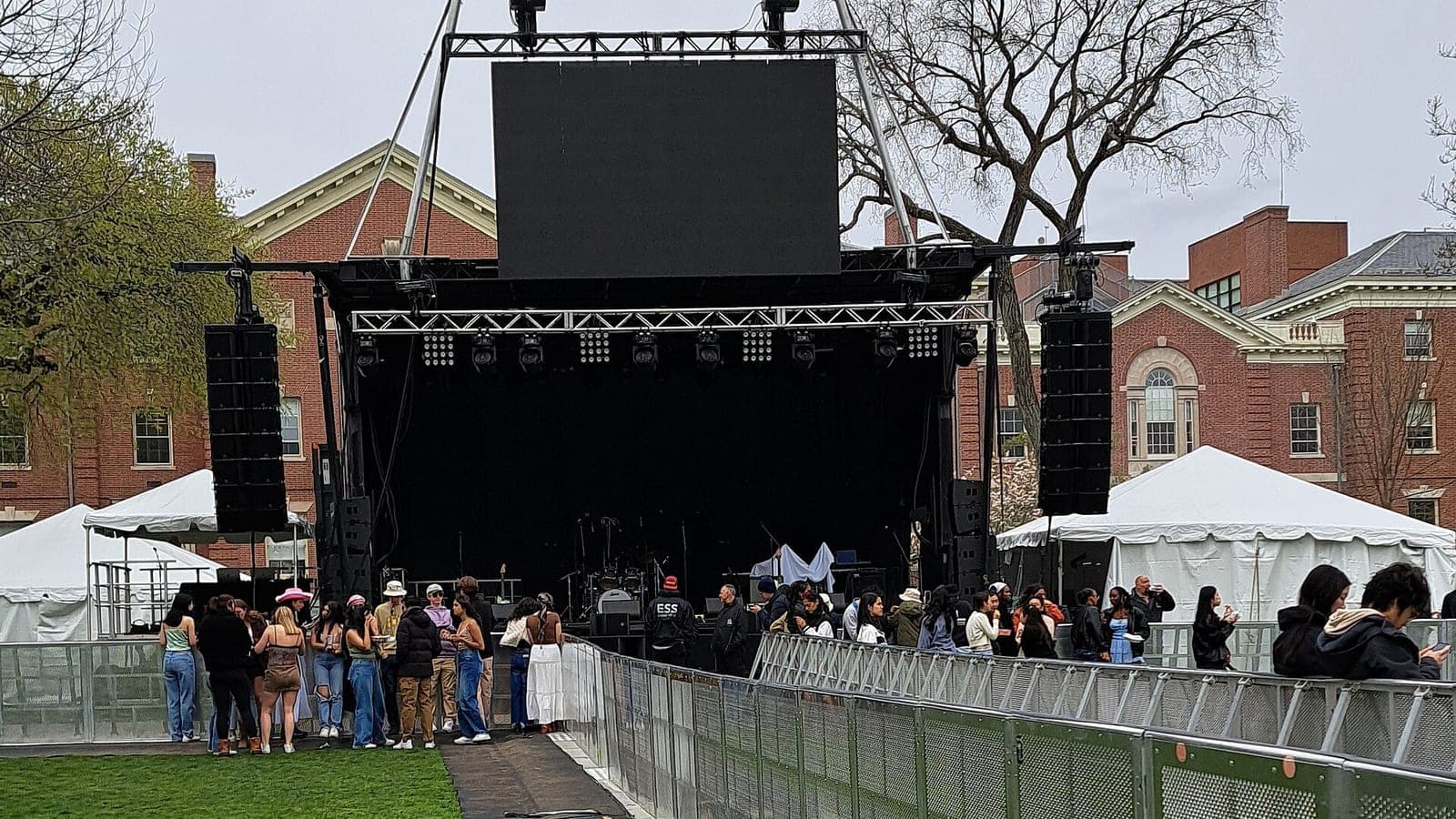
The ceiling for amplified music is the same across Belgium — 100 dB(A) — but the route to reach it changes from region to region. Flanders makes it conditional on prior authorisation from the town council. Brussels requires an environmental permit or a declaration filed two months in advance. Wallonia depends on the category the organiser declares. The three thresholds are always 85, 95 and 100 dB(A).
What noise limit applies to an event with music in Belgium?
Noise is a regional competence, so there's no single Belgian rule. There are three, and all three use the same scale of levels but with different procedures and obligations.
In Flanders, VLAREM II is the governing rule, amended by the Besluit van de Vlaamse Regering of 17 February 2012, published in the *Belgisch Staatsblad* on 29 March 2012 and in force since 1 January 2013. It added article 5.32.2.2bis for classified establishments and a chapter 6.7 for *niet-ingedeelde muziekactiviteiten*: non-classified musical activities, which is where a festival, a marquee event or a village party falls.
In Brussels, the arrêté of the Brussels-Capital Region Government of 26 January 2017 sets the conditions for broadcasting amplified sound in establishments open to the public. Its article 18 states that it enters into force one year after publication in the *Moniteur belge*: it was published on 21 February 2017 and has applied since 21 February 2018.
In Wallonia, the arrêté of the Walloon Government of 13 December 2018, published on 21 February 2019, replaced a 1977 rule. Its article 1, point 2, defines an establishment open to the public as «tout lieu permanent ou temporaire… y compris celui qui est en plein air» (any permanent or temporary venue… including one that is outdoors), and expressly excludes «cortèges, défilés et autres manifestations itinérantes similaires» (processions, parades and other similar itinerant events). A carnival procession doesn't count; a fenced-off site in a field does.
What do you need to apply for in Flanders to exceed 85 dB(A)?
Authorisation from the college of mayor and aldermen, requested before the event. Without it, the non-classified musical activity is capped at 85 dB(A) LAeq,15min, the level VLAREM II allows without any procedure.
Article 6.7.3 only allows the college to authorise a higher level if two conditions are met: the level at the venue does not exceed 100 dB(A) LAeq,60min, and the musical activity is tied to a special occasion. Above 100 dB(A) LAeq,60min, no authorisation is possible: «muziekactiviteiten met een geluidsniveau in de inrichting van > 100 dB(A)LAeq,60min zijn verboden» (musical activities with a sound level in the establishment of > 100 dB(A)LAeq,60min are prohibited).
The obligations come from article 5.32.2.2bis of VLAREM II, which chapter 6.7 imports in tiers:
- Between 85 and 95 dB(A) LAeq,15min. The level is measured continuously and must be «continu zichtbaar voor en wordt continu bewaakt» (continuously visible to and continuously monitored by) the operator or a person they appoint. Measurement can be replaced by a limiter set to the maximum permitted level.
- Between 95 and 100 dB(A) LAeq,60min. LAeq,60min and LAeq,15min are measured continuously, the LAeq,60min is logged, and the log is kept available for inspection for at least a month. Single-use hearing protection is handed out free to all visitors.
- In both tiers. The maximum authorised level is displayed «op een duidelijk zichtbare plaats» (in a clearly visible place), both at the entrance to the musical activity and at the mixing desk.
There's a concession for events: in the top tier, chapter 6.7 applies the regime of 5.32.2.2bis §2 except for the obligation to draw up a sound plan. That requirement is reserved for permanent establishments.
The municipal bylaw carries as much weight as VLAREM
Authorisation is municipal, and the college can attach conditions: a specific maximum level, the duration of the musical activity and a closing time. Ghent publishes its own scheme, which shows how a large city translates this into practice: events default into category 1, at 85 dB(A) LAeq,15min or 92 dB(A) LAmax,slow, and exceeding it requires an exemption request to the college.
A permanent venue is a different matter: heading 32.1.1 of VLAREM is handled with a 20-day *melding* (notification) and allows up to 95 dB(A) LAeq,15min on a permanent basis; heading 32.1.2 requires an environmental permit, which Ghent puts at 105 days of processing once the file is complete, and reaches 100 dB(A) LAeq,60min.
The same page is a reminder of the other sound-related bill: the music licence. That's no longer about noise, it's about copyright, and it runs through Unisono. We cover that in our guide on ticket sales, resale, VAT and Sabam in Belgium. And municipal conditions can go well beyond volume: in 2026, Tomorrowland was left without pyrotechnics by administrative decision.
What does Brussels require: permit, declaration or exemption?
All three, and they're not the same thing. Brussels Environment breaks them down as follows:
- Environmental permit if the sound installation falls under headings 135a or 135b of classified installations and the venue exceeds 200 m².
- Class 3 declaration, heading 135c, to broadcast amplified sound between midnight and 7:00, regardless of the level. It's filed with the municipality's environmental department at least 60 days before an outdoor or marquee event.
- Neighbourhood noise exemption, requested from the mayor more than 60 days in advance when it isn't possible to lower the level and still comply with neighbourhood noise rules. The decision is issued within a maximum of 45 days.
Levels run by category. Category 1 cannot exceed 85 dB(A): «le niveau LAeq,15minutes, glissant ne peut pas dépasser 85dB(A)» (the rolling LAeq,15min level cannot exceed 85dB(A)). Category 2 reaches 95 dB(A) and 110 dB(C) measured over 15 minutes, with a pictogram and a visible level display in each room or on each stage. Category 3 reaches 100 dB(A) and 115 dB(C) measured over 60 minutes, and adds four obligations: a level log, CE-marked earplugs either free or at manufacturer's cost price, a rest area covering around 10% of the space accessible to the public and kept below 85 dB(A) LAeq,15min, and a reference person trained in amplified sound and with a hearing test.
The arrêté goes down to the detail of the setup, and it's worth reading before buying the equipment. The display must be «à l'abri de toutes manipulations par le public» (protected from any tampering by the public). The measuring microphone is placed between 1.2 and 5 metres high and at least one metre from walls and speakers. And the equipment is calibrated once a year. Brussels Environment's guide stresses a point that's easily forgotten: meeting the category doesn't exempt you from general neighbourhood noise rules or from the conditions of the environmental permit.
What changed in Wallonia since the 2018 arrêté?
The scale is the same, but the order of the procedure is different: in Wallonia there's no prior authorisation of the level, there's a category that the establishment declares and whose obligations it takes on.
Category 1 stays at 85 dB(A) LAeq,15min, with public information via pictogram. Category 2 reaches 95 dB(A) LAeq,15min and 110 dB(C) LCeq,15min, with a real-time level display. Category 3 reaches 100 dB(A) LAeq,60min and 115 dB(C) LCeq,60min, and its article 5 adds four things: free earplugs with at least 15 dB of attenuation, a rest area covering at least 5% of the accessible surface and kept below 85 dB(A), a trained technical officer with a hearing test, and a level log kept for at least 30 days.
The arrêté left its own entry into force in the hands of the Government — article 14 — and opened a six-month transitional period for existing establishments to declare their chosen level. That the rule is in force was confirmed by minister Yves Coppieters when answering, on 19 March 2025, a written question in the Walloon Parliament from MP Valérie Warzée-Caverenne: the legislation is already in force and the aim is to strengthen it. His answer describes the three categories as we've summarised them here.
The three regions, side by side
The table compares what an organiser has to decide before booking the sound equipment. The figures come from the three rules linked in the sections above.
| Requirement | Flanders | Brussels | Wallonia |
|---|---|---|---|
| Rule | VLAREM II, ch. 6.7 and art. 5.32.2.2bis | Arrêté of 26 January 2017 | Arrêté of 13 December 2018 |
| Applicable since | 1 January 2013 | 21 February 2018 | Date set by the Government; in force as of 2025 |
| Level without procedure | 85 dB(A) LAeq,15min | 85 dB(A) LAeq,15min glissant (rolling) | 85 dB(A) LAeq,15min |
| Middle tier | 95 dB(A) LAeq,15min | 95 dB(A) and 110 dB(C), 15 min | 95 dB(A) and 110 dB(C), 15 min |
| Maximum ceiling | 100 dB(A) LAeq,60min | 100 dB(A) and 115 dB(C), 60 min | 100 dB(A) and 115 dB(C), 60 min |
| Ceiling in dB(C) | Not set out in the text | 110 and 115 dB(C) | 110 and 115 dB(C) |
| Who authorises the level | College of mayor and aldermen | Category plus permit or declaration | Declared category |
| Level log | Yes in the top tier, 1 month minimum | Yes in category 3 | Yes in category 3, 30 days minimum |
| Free earplugs | Above 95 dB(A) | Category 3, CE-marked | Category 3, 15 dB attenuation |
| Rest area | Not required by the text | Around 10% of the accessible space | 5% of the accessible surface |
Two observations of our own from that table. The first: Flanders is the toughest region on procedure and the most relaxed on the spectrum, because it sets no dB(C) ceiling in the published text, while Brussels and Wallonia cap it 15 dB above the dB(A) level of the top category. On a stage with heavy sub-bass, that headroom in the low end changes the system design. The second: Brussels' rest area, at around 10% of the space accessible to the public, is double Wallonia's, and doesn't exist at all in Flanders. It's a capacity obligation, not a sound one, and it gets decided on the venue floorplan, not at the mixing desk.
And your technical crew? Workplace noise is covered by a different rule
Regional rules protect the public. Whoever works at the event is protected by book V, title 2 of the Code on wellbeing at work, which is federal. The Federal Public Service for Employment publishes the three daily exposure thresholds: lower action value at 80 dB(A) and 112 Pa of peak pressure, upper action value at 85 dB(A) and 140 Pa, and exposure limit value at 87 dB(A) and 200 Pa.
What changes at each step is also precisely defined. From 80 dB(A), the employer makes hearing protection available, informs and trains the worker, and arranges health surveillance. From 85 dB(A), wearing protection becomes compulsory, noise-reduction measures must be applied, and hazardous areas must be signposted. The Beswic knowledge centre adds the detail that decides everything at a festival: checking the limit value takes into account the attenuation of the protection the worker is actually wearing, while the action values don't.
That's where the sum nobody does comes in. A stage authorised at 100 dB(A) uses up the 87 dB(A) daily limit value in 24 minutes. This is our own calculation using the formula for daily exposure normalised to eight hours: 87 = 100 + 10 × log(T/8) gives T = 0.40 hours. A monitor engineer on a five-hour shift at that level builds up around 98 dB(A) over eight hours, eleven decibels above the limit value. With 15 dB earplugs, that same shift drops to around 83 dB(A) and back into legal territory. This isn't an occupational health recommendation: it's the difference between complying with title 2 and not complying with it.
How much does non-compliance cost?
In Flanders, a lot on paper. VLAREM conditions are policed under title XVI of the decree of 5 April 1995, and its article 16.4.27 sets the ceilings for the administrative penalty: «maximaal [400.000] euro» (maximum 400,000 euro) for the exclusive fine and «maximaal [2.000.000] euro» (maximum 2,000,000 euro) for the alternative one. These are general ceilings for environmental penalties, not the typical fine for a decibel breach, but they show the order of magnitude a case can reach.
In Brussels, the range is published. Brussels Environment explains that the alternative administrative fine under the Inspection Code runs «de 50 à 62.500 €» (from 50 to 62,500 €), with a cap of 125,000 euros for repeat offences or accumulated breaches, and that minor breaches can be settled with an administrative settlement whose total «ne peut toutefois pas excéder 2.500 €» (may not, however, exceed 2,500 €). The amount depends on the nature of the facts, the severity, the professional context and any repeat offences in the previous three years.
For Wallonia, we haven't found the penalty range in a primary source, so we're not giving one. And it's worth not focusing only on the fine: in Flanders, the body that authorises the level is the same college you'll have to ask again the following year. An environmental police report weighs more in that file than any amount.
Checklist before opening the stage
Seven checks, in the order you need to do them.
Identify the region before the municipality. Work out which rule applies — Flemish, Brussels or Walloon — and which category you want to be in. That decision shapes the sound budget, the venue floorplan and the administrative timeline.
Count 60 days in Brussels. The class 3 declaration to broadcast sound between midnight and 7:00, and the neighbourhood noise exemption, both need to be requested 60 days in advance, and the answer to the exemption can take up to 45 days. If the event is six weeks away, the level has already been decided by the calendar.
Request Flemish authorisation in writing, with the level included. Article 6.7.3 requires a prior application to the college and only allows authorisation up to 100 dB(A) LAeq,60min for a special occasion. Keep the authorisation with the level and schedule stated on it: that's what the inspection will check.
Decide who monitors the level and name them. The Flemish middle tier requires the level to be visible and continuously monitored by the operator or someone they appoint. Brussels and Wallonia both require, at the top category, a trained person or technical officer with a hearing test.
Lock down the level log. One month's retention in Flanders, 30 days in Wallonia. Check that the equipment exports the history before the event, not after: without a log, there's no way to prove you complied.
Buy earplugs and mark the rest area on the floorplan. Free for all the public at the top tiers in all three regions, with 15 dB of attenuation in Wallonia and CE marking in Brussels. Brussels' rest area runs to around 10% of the accessible space: that's floor area that comes out of the capacity count.
Treat your crew as exposed workers. Provide hearing protection from 80 dB(A), make it compulsory from 85, and document the health surveillance. And if you're invoicing production or equipment hire to another Belgian company, also check the obligation to issue structured invoices via Peppol.
And what part of this does Futura Tickets cover?
No ticketing platform lowers a single decibel. What the sales and access system does touch is the other side of the file: how many people are inside, in which zone and at what time — the data used to size a rest area, justify a capacity figure to the municipality, or close off an access point. Futura Tickets is a Spanish SaaS ticketing platform for professional organisers, with access control and zone-by-zone capacity management; you can see it on the product page. The decibels get sorted out at the mixing desk and in the municipal file.
Conclusion
Belgium has a single ceiling and three doors. Nobody raises the ceiling — 100 dB(A) measured over 60 minutes. The doors are: municipal authorisation in Flanders, a permit or a declaration filed 60 days in advance in Brussels, and a declared category in Wallonia. Anyone organising in more than one region can't reuse the paperwork: the deadlines, the dB(C) ceilings, the rest area and the log retention period all change. If you're coming from another market, comparing this with the municipal event permit in the Netherlands helps show just how much gets decided at local level.
Sources
- Besluit van de Vlaamse Regering of 17 February 2012 amending VLAREM on musical activities (Belgisch Staatsblad, 29 March 2012)
- VLAREM II, article 5.32.2.2bis: maximum levels, measurement, logging and hearing protection (Kustcodex, Flemish Government)
- Decree of 5 April 1995, article 16.4.27: maximum amounts of the administrative fine (Kustcodex)
- Arrêté of the Brussels-Capital Region Government of 26 January 2017 on broadcasting amplified sound (Justel, Moniteur belge)
- Arrêté of the Walloon Government of 13 December 2018 on electronically amplified sound (Moniteur belge, 21 February 2019)
- Broadcasting amplified sound: rules and authorisations required (Brussels Environment)
- Electronically amplified sound: obligations of establishments (Brussels Environment)
- What to do in the event of an environmental breach: amounts of the alternative administrative fine (Brussels Environment)
- Bruit: exposure values under book V, title 2 of the Code on wellbeing at work (SPF Emploi, Travail et Concertation sociale)
- Bruit: thresholds and employer obligations (Beswic, Belgian knowledge centre on wellbeing at work)
- Written question of 19 March 2025 and reply from minister Yves Coppieters on the noise rules (Walloon Parliament)
- Environmental permit for electronically amplified music: categories and timelines (City of Ghent)