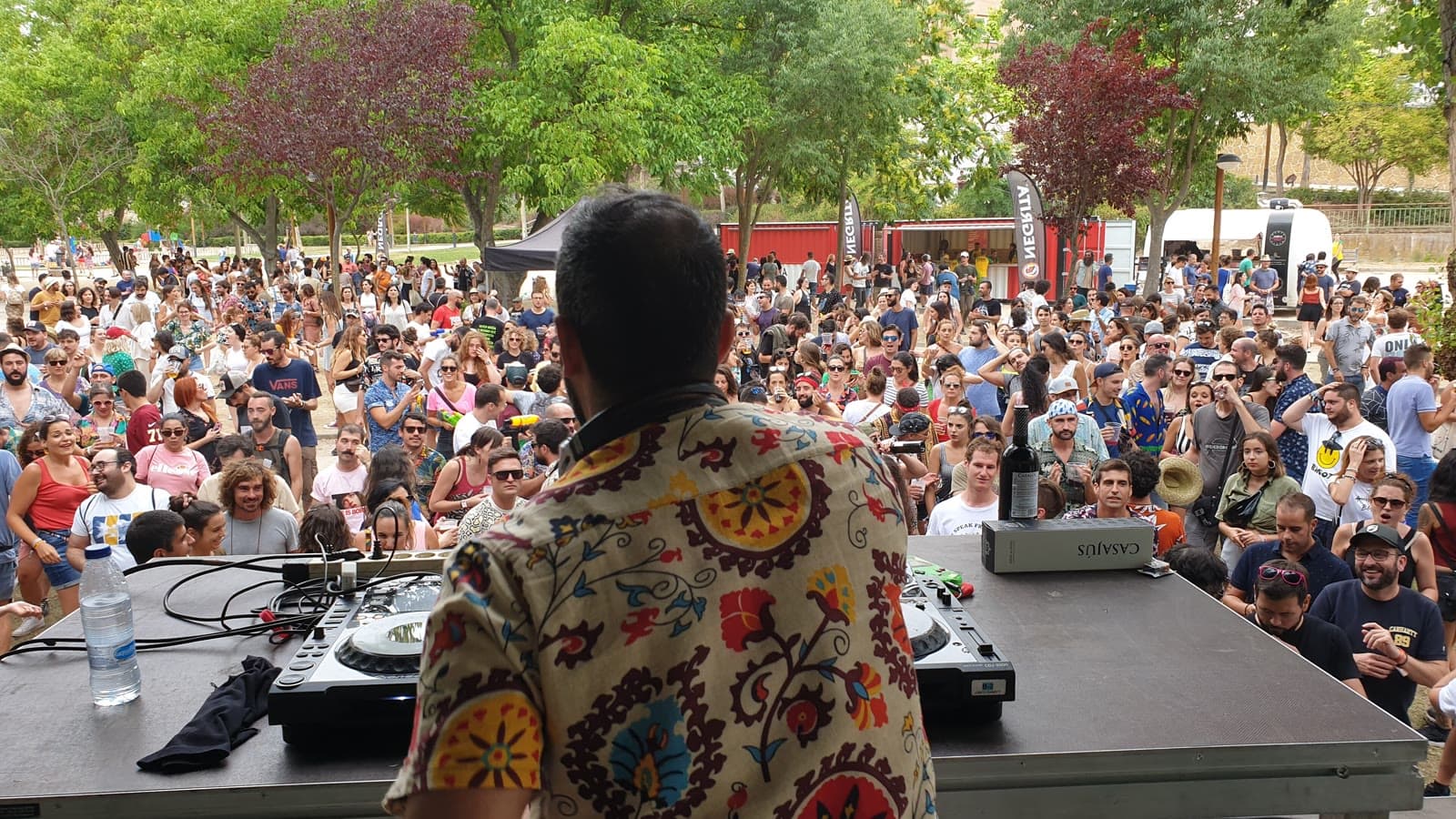
There is no national decibel figure a concert cannot exceed. What exists are acoustic quality targets by zone type, a municipal permit that can suspend them for the duration of the event, and regional rules that don't agree with one another. The limit that applies to you isn't set by your stage: it's set by the acoustic zone of the venue and the town council that signs off on the authorisation.
What noise limit applies to an event in Spain?
The national framework doesn't regulate how loud a stage can be, but how much noise can reach the surrounding area. Annex II of Royal Decree 1367/2007 sets acoustic quality targets for existing urbanised areas: 55 dB(A) at night in a residential-use area (type a) and 63 dB(A) in a recreational and entertainment area (type c). The difference might look small, but it isn't. Between 63 and 55 dB(A) there are 8 decibels, and because the scale is logarithmic, that equates to roughly 6.3 times more sound energy — this is our own calculation based on table A, not a figure stated in the Royal Decree.
That's where the first decision in your event's paperwork comes from: knowing which acoustic zone the venue sits in and who the nearest sensitive receptor is. Zoning is approved by regional governments and town councils, and the Royal Decree itself requires it to be reviewed at least every ten years. If the venue sits right next to housing, the residential target applies, even if the use inside the fence is recreational.
What do Law 37/2003 and Royal Decree 1367/2007 say?
Law 37/2003, of 17 November, on Noise is the framework law. It contains no decibel figures: it allocates powers, creates noise maps, special acoustic protection zones (article 25) and special acoustic situation zones (article 26), and refers the detail to secondary legislation. Royal Decree 1367/2007, of 19 October, is that secondary legislation, amended by Royal Decree 1038/2012, of 6 July, which adjusted table A of Annex II to comply with a court ruling.
This is the table used in any acoustic study for an event. It shows day, evening and night noise index values, in dB(A), for existing urbanised areas.
| Acoustic zone type | Ld (day) | Le (evening) | Ln (night) |
|---|---|---|---|
| e) Healthcare, education and culture | 60 | 60 | 50 |
| a) Residential | 65 | 65 | 55 |
| d) Non-recreational tertiary | 70 | 70 | 65 |
| c) Recreational and entertainment | 73 | 73 | 63 |
| b) Industrial | 75 | 75 | 65 |
Annex III adds limit values for noise transmitted into buildings, which range between 25 and 40 dB(A) depending on the type of receiving space and the time period. This is the figure that turns up in neighbours' complaints: it isn't measured at the festival fence, it's measured in the living room of whoever calls the local police.
Can the town council lift the limit for your event?
Yes, and it's the piece most often forgotten in the permit file. Article 9 of Law 37/2003 allows acoustic quality targets to be provisionally suspended for events of special official or cultural significance, or when best available techniques don't allow them to be met, provided this is adequately justified. It isn't a blank cheque: it's a prior decision, limited to certain zones and a set time window, and it must be justified.
Regional governments have written that exception in their own words. In Catalonia, article 20 bis of Law 16/2002, added by Law 3/2023, of 16 March, states that "con motivo de la organización de actos tradicionales, festivos, deportivos, culturales o de otro tipo, que tengan un especial arraigo o interés social, los municipios pueden adoptar, en determinadas zonas y previa valoración del impacto acústico, la suspensión provisional de los objetivos de calidad acústica" (for traditional, festive, sporting, cultural or other events with particular local roots or social interest, municipalities may adopt, in specific zones and following an assessment of acoustic impact, the provisional suspension of acoustic quality targets). In the Balearic Islands, article 14 of Law 1/2007 requires the same thing, "previa valoración de la incidencia acústica" (following an assessment of acoustic impact). That assessment isn't a formality: it's the document you'll be asked for if anyone complains.
What does each region require?
Four regions have their own law with written rules that directly affect an event. Each cell reflects what the regulation states, not a recommendation of ours.
| Region | Regulation | Exception for festive events | Other written requirement | Maximum fine |
|---|---|---|---|---|
| Catalonia | Law 16/2002 | Article 20 bis: provisional suspension by the municipality, following assessment of acoustic impact | ZARE from 10 dB(A) excess (article 8) | €450,000 (article 33) |
| Valencian Community | Law 7/2002 | First additional provision: temporary exemption for official, cultural, festive or religious events | Outdoor licences must set maximum sound power levels (article 40) | €60,000 (article 58) |
| Castile and León | Law 5/2009 | Article 10: provisional suspension of limit values for events of special significance | A power limiter-controller may be required (article 26.2) | No figure located in the consolidated text |
| Balearic Islands | Law 1/2007 | Article 14: temporary suspension of acoustic quality targets | Acoustic study required in outdoor music activity projects (article 43) | No figure located in the consolidated text |
The last two fine cells are deliberately left open: in the consolidated texts published in the BOE for Law 5/2009 and Law 1/2007 we found the classification of offences, but not the amounts. Before citing a figure, it's worth reading the full sanctions title in the regional gazette.
Andalusia regulates the matter by decree, through Decree 6/2012, published in BOJA issue 24 of 6 February 2012. Madrid applies, within the capital, the Ordinance on Protection against Noise and Thermal Pollution of 25 February 2011, with its own special acoustic protection zones and strategic noise maps, according to the municipal noise management portal. Before sizing your sound system, check which ordinance your town council applies: the same venue can have a different schedule and figure elsewhere.
The Valencian Law 7/2002 goes furthest with indoor figures. Its article 39.1 uses reference sound levels to calculate the required soundproofing: 104 dB(A) for nightclubs, discos and cabaret venues, 90 dB(A) for premises with background music, and 85 dB(A) for bingo halls and gaming venues. Between that 104 and the residential night-time target of 55 dB(A) there's a 49-decibel gap, which has to be closed through soundproofing, distance or stage orientation. That calculation is ours; the law only sets the endpoints.
How much noise can your production crew take?
This is the part almost no event's paperwork resolves, and it's the one with hard numbers. Royal Decree 286/2006, of 10 March protects workers against noise and has applied to the music and entertainment sectors since 15 February 2008, when the transitional provision that excluded them expired. Article 5 sets three thresholds: an exposure limit value of 87 dB(A) and a peak of 140 dB(C); upper action values of 85 dB(A) and 137 dB(C); and lower values of 80 dB(A) and 135 dB(C).
All three thresholds refer to the daily equivalent exposure level, normalised to eight hours, as set out in Annex I of the Royal Decree itself and explained in the 2022 INSST technical guide. Let's run the numbers, which is our own calculation: a technician working at a point with 100 dB(A) reaches the 87 dB(A) daily limit value in about 24 minutes, and the 85 dB(A) upper value in about 15 minutes. A full festival shift doesn't fit into that without hearing protection.
What Royal Decree 286/2006 actually requires
The obligations scale by threshold and are verifiable during an inspection. Article 7.1.a) requires individual hearing protectors to be made available to workers once the lower values are exceeded, and 7.1.b) makes their use mandatory once the upper values are met or exceeded. Article 6.4 sets the assessment frequency: annually for posts where the upper values are exceeded, and every three years where the lower values are exceeded. Article 11.2 sets audiometric checks every three years for those exposed above the upper values, and every five years for those above the lower values.
Translated into production terms: bar staff, stage crew, FOH, private security and access control are all workplace roles. The same measurement you use for the surrounding area doesn't apply here, because the worker moves around and what matters is their daily dose. If you outsource security or sound, the supplying company holds that documentation and you coordinate it. This fits alongside the rest of the event safety plan and the coordination of business activities you already carry out for build and evacuation.
What fine could you face for noise at an event?
The amounts are set out in law and they aren't symbolic. The sanctions regime under Law 37/2003 (articles 28 to 30) classifies offences as very serious, from €12,001 to €300,000; serious, from €601 to €12,000; and minor, up to €600. Alongside the fine, authorities can revoke the licence, temporarily or permanently close the venue, seize equipment and publish the penalty. The town council is almost always the one that issues the sanction, because monitoring activities is a local responsibility.
Regions raise the ceiling. Article 33 of Catalonia's Law 16/2002, as amended by Law 3/2023, sets minor offences at up to €1,500, serious ones between €1,501 and €20,000, and very serious ones between €20,001 and €450,000. Article 58 of the Valencian Law 7/2002 sets €6,001 to €60,000 for very serious offences, €601 to €6,000 for serious ones, and €60 to €600 for minor ones. At a three-day festival, the real risk isn't the isolated fine: it's the session being suspended and the precedent it sets for next year's licence application.
What happens if the venue is in an acoustically saturated zone?
Then the margin disappears before you even arrive. Town councils can declare specially treated zones when noisy activities build up, and each law sets its own numerical threshold. In Catalonia these are called ZARE, and article 8 of Law 16/2002 allows them to be declared in zones where immission limit values for moderate-sensitivity acoustic zones are exceeded "en 10 dB(A) o más, dos veces por semana, durante dos semanas consecutivas o tres de alternas, dentro del plazo de un mes" (by 10 dB(A) or more, twice a week, for two consecutive weeks or three alternate weeks, within one month).
In the Valencian Community these are called ZAS, and article 28.2 of Law 7/2002 requires assessment levels to be exceeded by more than 20 dB(A), twice a week for three consecutive weeks or three alternate weeks within thirty-five calendar days. Castile and León regulates these in article 48 of its Law 5/2009. In parallel, Law 37/2003 maintains the special acoustic protection zones under article 25 and the special acoustic situation zones under article 26, with phased improvement plans.
The context helps explain why town councils are tightening up. According to the INE's quality of life indicators, in 2023, 23.5% of people in Spain reported problems with noise from neighbours or from outside, compared with 18.2% across the European Union; the highest figures were in Ceuta (39.3%), the Canary Islands (30.0%) and Melilla (29.9%). An outdoor event steps into territory where the neighbourhood already has its complaint ready.
Where does your ticketing platform fit into this?
Barely at all, and it's worth saying so: a ticketing system doesn't measure decibels. What it does hold are two pieces of data the acoustic file constantly relies on: the schedule you've committed to and capacity by zone. If the authorisation limits music to 1am, that needs to be reflected in the sales conditions and on the ticket itself, not just in the production run sheet. In its operational guide, Futura Tickets recommends setting capacity alerts at 80% and 95% of each zone's capacity, which is the same threshold worth using to monitor occupancy in the zones closest to housing. If you're choosing a tool, the scheduling and zoning section of the ticketing software matters more than it seems — until inspection day.
What to do before opening sales
Seven checks. None needs an 80-page report, and all of them can be done this week.
Find out the acoustic zone of the venue and the nearest sensitive receptor. This is the figure that determines whether your night-time target is 55, 63 or 50 dB(A), according to table A of Royal Decree 1367/2007. Without it, any sound budget is a guess.
Request the exception in writing, with a time window. If the event fits article 9 of Law 37/2003 or Catalonia's article 20 bis, the suspension of targets must be requested in advance, with an acoustic impact assessment and defined zones. A verbal nod from a councillor isn't an exception.
Check whether your town council requires a limiter or an acoustic study. In Castile and León, a frequency-band power limiter-controller can be required (article 26.2 of Law 5/2009), and in the Balearic Islands, the outdoor music activity project must include an acoustic study (article 43 of Law 1/2007).
Set the measurement points and who measures. Decide with your acoustic engineer where measurements are taken, on the façade and inside affected buildings, and how often during the event. Keep the records: they're your evidence if challenged.
Treat your crew as exposed workers. Assess exposure at the bar, stage and access points, provide hearing protection from 80 dB(A) and require it from 85 dB(A), with documented coordination if you outsource.
Put the music curfew in your sales conditions. If you cut it mid-campaign, you'll have a consumer problem on top of the noise one, just as with changes to a refund policy.
Notify the neighbourhood and leave a phone number. It isn't a requirement under the Noise Law, but a complaint handled on the spot rarely ends up on an inspection report. If you're organising a festival, this belongs in the same package as event permits and licences and the production schedule.
Noise isn't the minor chapter of the paperwork. It's the one thing that can stop the show mid-set, with the venue full and next year's licence hanging on an inspector's report.
Sources
- Ley 37/2003, de 17 de noviembre, del Ruido (texto consolidado, BOE)
- Real Decreto 1367/2007, de 19 de octubre, de zonificación acústica, objetivos de calidad y emisiones acústicas (texto consolidado, BOE)
- Real Decreto 1038/2012, de 6 de julio, por el que se modifica el Real Decreto 1367/2007 (BOE)
- Real Decreto 286/2006, de 10 de marzo, sobre protección de los trabajadores frente al ruido (texto consolidado, BOE)
- Ley 16/2002, de 28 de junio, de protección contra la contaminación acústica de Cataluña (texto consolidado, BOE)
- Ley 7/2002, de 3 de diciembre, de protección contra la contaminación acústica de la Comunitat Valenciana (texto consolidado, BOE)
- Ley 5/2009, de 4 de junio, del Ruido de Castilla y León (texto consolidado, BOE)
- Ley 1/2007, de 16 de marzo, contra la contaminación acústica de las Illes Balears (texto consolidado, BOE)
- Decreto 6/2012, de 17 de enero, Reglamento de Protección contra la Contaminación Acústica en Andalucía (BOJA núm. 24)
- Gestión del ruido ambiental en la ciudad de Madrid (Ayuntamiento de Madrid)
- Ruido: riesgos físicos (INSST)
- Guía técnica para la evaluación y prevención de los riesgos relacionados con la exposición al ruido en los lugares de trabajo, 2022 (INSST, PDF)
- Indicadores de calidad de vida: ruidos producidos por vecinos o del exterior (INE)